Finally ..... my 1st Essay
What are the main questions - themes characterize the functionalism of a Malinowski or the structural functionalism a Radcliffe-Brown? Discuss the review in theory and method, which brought the two founding figures of British anthropology in the academic tradition.
Bronislaw Kaspar Malinowski
(1884 - 1942) and Alfred Reginald Radcliffe-Brown (1881 - 1955) are amongst the leading British anthropologists of the early 20th Century.
The simultaneous publication of Malinowski's "Argonauts of the Western Pacific. An Account of Native Enterprise and Adventure in the Archipelago of Melanesian New Guinea, and Radcliffe-Brown's "The Andaman Islanders" in 1922 - a time marked by the debate between evolutionism and Diffusionismus is - marks a turning point in British anthropology.
Malinowski collects the data for his monograph "Argonauts of the Western Pacific" during his (intermittent) nearly 3-year stay on the Trobriand Islands in Melanesia (1915 - 1918). Overall, Malinowski written three monographs on the Trobriand, which are collected at that visit, impressions and findings and basis for his theoretical writings. In Argonauts of the Western Pacific "Malinowski is the main emphasis in the ceremonial exchange system of the Trobriand - kula - apart. In the introduction he demonstrates his revolutionary method of field research before - the participant observation.
Radcliffe-Brown's monograph "The Andaman Islanders" is based on a research trip that he already 1906 - 1908 led by the now one of India belonging to Andaman Islands in the Bay of Bengal. The first four chapters of the book, Radcliffe-Brown writes just after his return, they consist primarily of ethnographic material, the description of social phenomena, ceremonies and myths as well as underlying religious ideas. From 1910 to 1912 Radcliffe-Brown research at the Aborigines in Western Australia, during which time he also deals with the work of Frenchman Emile Durkheim. By 1914, Radcliffe-Brown writes, finally his analysis of the collected data down to the Andaman Islands.
functionalism
Bronislaw Malinowski is considered the founder of functionalism. Basis of functionalism is the view that all socio-cultural phenomena can be viewed only in terms of their function. Functionalism is based on a holistic approach: culture is viewed as a whole, the elements (objects, attitudes and actions) are in mutual dependence. Functionalism is an ahistorical approach, which means that cultural elements are defined only by its function in the present. This is also a major point of Opponents of functionalism. Furthermore, functionalism has been criticized as a static theory, changes are not considered.
In his late work "A Scientific Theory of Culture" (1944) sums up his Malinowski theoretical considerations: his concept of function is basically oriented to the basic human needs. He goes out of seven biological needs of the people and their cultural "responses" (such as reproduction - relationship). Function can be viewed as a performance of a socio-cultural phenomenon with respect to satisfying a need. This biological orientation is including criticized by Radcliffe-Brown.
"Functionalism shaped the anthropology profound, although he was under the influence of Radcliffe-Brown soon would undergo the transformation to structural functionalism." (Page 280, Feest / carbon, major works of Ethnology)
structural functionalism
The Radcliffe-Brown's structural functionalism
operates at a higher abstraction level than Malinowski's functionalism. Basically, the question of the function of socio-cultural processes in relation to the functioning of the social structure (skeleton) is a society. The individual is in the analysis of such functions to no meaning.
In his monograph "The Andaman Islanders" analyzes Radcliffe-Brown, for example, the social function of ceremonies. This he sees in the generation of emotions, which ultimately secure the cohesion of the community.
criticized the structural functionalism is primarily for its overly strong focus on social structures and concomitant reduction of the individual (the individual is only a "roller support" of the meaning). As with the equally valid ahistorical functionalism and static orientation as criticisms. take
importance
directly to the next generation as both Malinowski Radcliffe-Brown also great influence as a teacher. Malinowski taught a long time at the London School of Economics. This is a long time the only institution in the UK, where the "new direction" of the British anthropology is taught. Radcliffe-Brown in England, however, can not take hold for a long time and teaches, among others, the universities of Alexandria, Cape Town, Chicago and Sydney. Only in 1937, he returned to England (Oxford) back.
Most importantly Malinowski's role as "father" of participant observation, he outlines the basic principles already in "Argonauts of the Western Pacific". Key points include the learning of the respective Language, participation in social life (up to the "going native") and the exact recording of the entire research process (where trigger Malinowski's own field research journals in the posthumous publication of great discussions).
Radcliffe-Brown's importance is likely to be found in the theoretical field. His goal was to establish a science of human society. This theory was able to sit down, but had his concept of the social structures of great influence on the work of his students and future generations.
Malinowski and Radcliffe-Brown are considered the founding fathers of British social anthropology. Their importance for the overcoming of evolutionism and Diffusionismus is undisputed.
Used literature:
Feest Christian F. and Karl-Heinz Kohl (Hsg), major works of anthropology, Alfred Kröner Verlag, Stuttgart, 2001
Panoff Michael and Michel Perrin, Pocket Dictionary of Anthropology. Terms and definitions for the introduction, Dietrich Reimer Verlag, Berlin, 2000
Barth Frederik, Gringrich Andre, Robert Parkin, Silverman Sydel, One Discipline, Four Ways: British, German, French and American Anthropology, University of Chicago Press, Chicago, 2005
Alan Barnard, History and Theory in Anthropology, Cambridge University Press, Cambridge, 2000
http://www.rzuser.uni-heidelberg.de/ ~ tkirrste / bronislaw_malinowski.html
http://www.rzuser.uni-heidelberg.de/ ~ tkirrste / alfred_r_radcliffe_brown . html
Thursday, November 24, 2005
Friday, October 21, 2005
Friday, May 20, 2005
Alberta License Plate Frame
A New Reformation!
In a kind of miracle, and with help from many, many people, we managed to write a book--now called "A New Reformation!" and print it and get it (80% of it) translated into German--all within about two weeks. The deadline was not our making but the circumstances of my invitation to speak on Pentecost at Bad Herlaub, an invitation which was scheduled six months previous but which loomed much bigger after the election of Benedict XVI. I felt the scandal of this, the first Inquisitor General to be named pope, would awaken people and inspire them to participate in the quest for a New Reformation. Thus an action at Wittenburg.
Giving a lecture to 500 people at Bad Herlaub and a workshop the next day for about 60 others, much feedback came my way. Most of it was very positive but several individuals expressed resistance. "Why don't you forgive Cardinal Ratzinger?" one lady asked me. "Because justice comes first and then forgiveness," I replied. "You should go to Assisi and to Benedict country, not to Wittenburg," said one man. But Assisi is for sweetness, what is called for now is resistance. And resistance is signified by Wittenburg.
Another woman said: "Why a New Reformation? That signifies church institutions. There must be a better term." I thought about that and a better term might be "Transformation." I do want to go beyond Reformation to Transformation and it is time. But Reformation is a first step. And Wittenburg is archetypal--it represents a place where one once stood up to church power and said: "Stop. No longer."
That is needed today too and with the unleashing of spirit and inspiration that this Pentecost season promises, hopefully this act might assist in getting us moving from Reformation to Transformation, from Religion to Spirituality. One can hope.
Today, Tuesday, we took two trains, one as far as Frankfurt and then we switched to a second train to Erfurt. We intended to spend one day in Erfurt and from there to journey to Wittenburg. Why Erfurt?
Erfurt was a theological center for many centuries and it is the town where Martin Luther was trained as a priest and ordained as one. It was also the town where Meister Eckhart lived and worked 150 years earlier for a period of four years. They have just finished a reconstruction of the main body of the Predigerkirche which was his church and which was quite badly damaged in the war and ignored during the Soviet occupation. However, the oldest section, where Eckhart and his Dominican brothers prayed and preached in the late thirteenth century, was not damaged much and still stands much as it did in his day. The choir stall, for example, are the original ones.
In my love and zeal to know Eckhart I once visited Erfurt years ago when it was part of "East Germany" and I was followed by the Stassi (German secret police) from the moment I arrived in my car which had West German license plates since I had rented it in West Germany. When I arrived at the pastor's place where I hoped to get keys to let me into the church there were three cars full of Stassi. I did not want to get the pastor into any trouble so I never got inside and just walked around the perimeter of the property instead.
This trip was different and very special. The pastor, who it turns out was under constant surveillance by the Stassi under the old East German regime, is a great lover of Eckhart and he showed us around the interior including the choir stall where Eckhart sat as prior (yes, I spent time in it meditating and so many of his famous one-liners came to me as I sat there), the altar where he said Mass for the community of 72 members, the very chapter room where he gave several of his well known treatises to novices and others, the refectory where they all ate. And we were allowed to look through a book that dates back to the fourteenth century that has been preserved in the parish office there.
Being in the sanctuary where Eckhart preached--what a great gift. Very moving. Sitting in the choir stall that was his six centuries ago--what a privilege! Standing at the altar where he celebrated Mass as prior of his community--what a grace! Also to visit the church where Martin Luther was ordained and said his first Mass and lived as a theology student. So much history from the past; so much that calls us to a reborn future. Especially at Pentecost time.
This proved to be a very special warm-up for our trip to Wittenburg later that day.
In a kind of miracle, and with help from many, many people, we managed to write a book--now called "A New Reformation!" and print it and get it (80% of it) translated into German--all within about two weeks. The deadline was not our making but the circumstances of my invitation to speak on Pentecost at Bad Herlaub, an invitation which was scheduled six months previous but which loomed much bigger after the election of Benedict XVI. I felt the scandal of this, the first Inquisitor General to be named pope, would awaken people and inspire them to participate in the quest for a New Reformation. Thus an action at Wittenburg.
Giving a lecture to 500 people at Bad Herlaub and a workshop the next day for about 60 others, much feedback came my way. Most of it was very positive but several individuals expressed resistance. "Why don't you forgive Cardinal Ratzinger?" one lady asked me. "Because justice comes first and then forgiveness," I replied. "You should go to Assisi and to Benedict country, not to Wittenburg," said one man. But Assisi is for sweetness, what is called for now is resistance. And resistance is signified by Wittenburg.
Another woman said: "Why a New Reformation? That signifies church institutions. There must be a better term." I thought about that and a better term might be "Transformation." I do want to go beyond Reformation to Transformation and it is time. But Reformation is a first step. And Wittenburg is archetypal--it represents a place where one once stood up to church power and said: "Stop. No longer."
That is needed today too and with the unleashing of spirit and inspiration that this Pentecost season promises, hopefully this act might assist in getting us moving from Reformation to Transformation, from Religion to Spirituality. One can hope.
Today, Tuesday, we took two trains, one as far as Frankfurt and then we switched to a second train to Erfurt. We intended to spend one day in Erfurt and from there to journey to Wittenburg. Why Erfurt?
Erfurt was a theological center for many centuries and it is the town where Martin Luther was trained as a priest and ordained as one. It was also the town where Meister Eckhart lived and worked 150 years earlier for a period of four years. They have just finished a reconstruction of the main body of the Predigerkirche which was his church and which was quite badly damaged in the war and ignored during the Soviet occupation. However, the oldest section, where Eckhart and his Dominican brothers prayed and preached in the late thirteenth century, was not damaged much and still stands much as it did in his day. The choir stall, for example, are the original ones.
In my love and zeal to know Eckhart I once visited Erfurt years ago when it was part of "East Germany" and I was followed by the Stassi (German secret police) from the moment I arrived in my car which had West German license plates since I had rented it in West Germany. When I arrived at the pastor's place where I hoped to get keys to let me into the church there were three cars full of Stassi. I did not want to get the pastor into any trouble so I never got inside and just walked around the perimeter of the property instead.
This trip was different and very special. The pastor, who it turns out was under constant surveillance by the Stassi under the old East German regime, is a great lover of Eckhart and he showed us around the interior including the choir stall where Eckhart sat as prior (yes, I spent time in it meditating and so many of his famous one-liners came to me as I sat there), the altar where he said Mass for the community of 72 members, the very chapter room where he gave several of his well known treatises to novices and others, the refectory where they all ate. And we were allowed to look through a book that dates back to the fourteenth century that has been preserved in the parish office there.
Being in the sanctuary where Eckhart preached--what a great gift. Very moving. Sitting in the choir stall that was his six centuries ago--what a privilege! Standing at the altar where he celebrated Mass as prior of his community--what a grace! Also to visit the church where Martin Luther was ordained and said his first Mass and lived as a theology student. So much history from the past; so much that calls us to a reborn future. Especially at Pentecost time.
This proved to be a very special warm-up for our trip to Wittenburg later that day.
Should Oyu Work Witha Chest Infection
A Report From Wittenburg
On Tuesday, four of us trooped to Wittenburg, the capital of the Protestant revolt , a three hour trip by car form Erfurt, Germany where we spent time in Meister Eckhart's priory. Four of us being Anne, a German citizen and mother of three boys who is also an avid reader and a mystic in her own right; Peter, an Englander who has been living in Germany for over twenty years and who has received a master's degree from Naropa Oakland; and Jim Garrison, president of Wisdom University and formerly president of the World Forum and the Mikael Gorbachev Foundation. And myself. Peter and Anne would prove to be invaluable not only as translators and interpreters but also as strategists and go-phers.
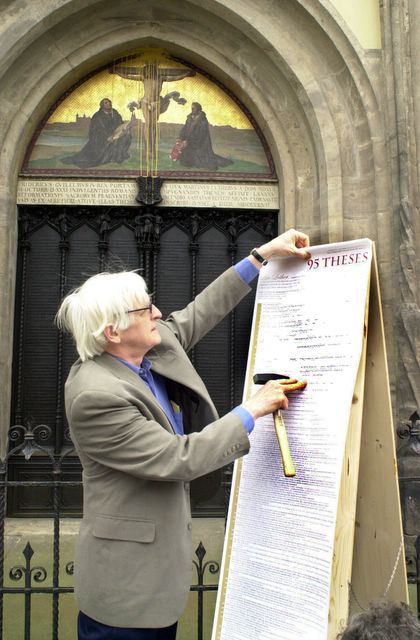
Our plans were to meet the press and others on Wednesday, May 18 at 4 PM at the door of Castle Church in Wittenburg where Luther nailed his 95 theses some 500 years ago. First, however, we had to stop by the city hall and get official documents to allow us to perform this action. The officials limited us to one hour (4-5 PM) and we were to station ourselves far away from the door "in order to let the tourists be unemcumbered in taking photos of the door." After considerable persuasion offered by Anne, they relented to allow us to be "near the door." But we could not pound nails into the door which today, unlike Luther's day, is no longer wood but metal casting containing his 95 theses. No pounding on that door even if one had permission to do so!
What to do? We decided on an A Frame board of two pieces 7feet by 2 feet held together by a flexible hinge since our scroll was about six feet in length. We set it up outside the short, four foot fence.
How telling it was to me that in the minds of the local authorities the tourists came first. More important than a group calling for a Reformation Today were the religious tourists (very few of them appeared to be pilgrims) who arrived in buses to take a photo at the door and move on. Didn't this fill out my point in the "New Reformation!" book that churches are museums today? Destination places for tourists rather than for pilgrims. And good for the economy (even if the economy may not be good for them!) This reality inspired me all the more to present my 95 theses.
Two nights previously we had heard the news that skinheads or Nazis youth of Wittenburg had defamed the doors in a protest by throwing bags of yellow paint on them. The paint still dripped from the painting at the top of the door but otherwise had been cleaned up by the time we arrived on Wednesday.
The German media was showing some interest. The editor of the very solid and influential theological magazine, " Publik-Forum " attended my talk in Bad Herrenalb and interviewed me for 90 minutes afterwards. It turns out he had left Christianity for some ten years or so and then reading Meister Eckhart brought him back. His photographer came to Wittenburg as did the photographer for " Bild " newspaper, a blue collar paper with ten million circulation whose editor interviewed me by phone that morning with Peter translating.
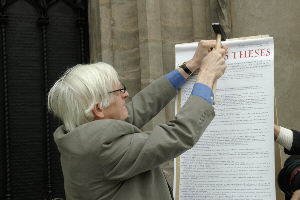
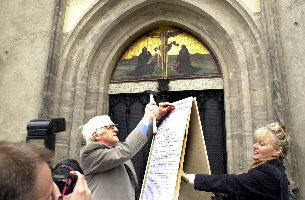
I retired inside the church to meditate and get out of the way of Peter and Anne who were building the A Frame apparatus. At 3:50 we received a call that the TV man who was coming was stuck in traffic and would be delayed forty minutes. What to do? We decided on two nailings of the theses. The first for the "Bild" and "Publik Forum" photographers. Then a pause and wait for the TV man to arrive. Only then did I give a brief talk, take questions, and nail the theses a second time.
In between the two events a bus arrived with many black people pouring out of it to look at the doors. They had an English-speaking tour guide. "Where are you from?" I asked one of them. "South Africa." When the guide had finished her speech, I spoke up and said: "I am a theologian from America and I am here to urge a New Reformation in our time and I invite you to stick around for a few minutes until the TV man arrives and hear more about what we are doing and why." The guide gave me a killer look and said "We are in a hurry to get to our next destination" but several members of the group hung back and said "this sounds far more interesting than what we are doing." They had to move on but we gave away about a dozen of the "New Reformation!" books to these South African tourists who, as they told me, were there to look into business connections with Germany.
One of the questions I received with the TV camara going was this: "Is this just about the corruption in the Catholic Church?" "No", I said. "The Protestant church is suffering differently from the Catholic Church--it is more from boredom and acedia, lack of energy to begin new things." And I cited a Protestant Pastor we met the day before who said he felt the church was essentially dead drawing as it does 5-8% of the population. A Reformation--better yet, a Transformation--is called for across the board as we enter a new millennium.
The day was chilly with clouds and some sun shining. The media, ranging from serious theological journal to TV station for the entire area (who promised to send us their footage in a few weeks) to the national blue collar newspaper to a local newspaper will presumably spread some seeds. More response may follow. At least we tried something to wake people up. We shall see what unfolds.
On Tuesday, four of us trooped to Wittenburg, the capital of the Protestant revolt , a three hour trip by car form Erfurt, Germany where we spent time in Meister Eckhart's priory. Four of us being Anne, a German citizen and mother of three boys who is also an avid reader and a mystic in her own right; Peter, an Englander who has been living in Germany for over twenty years and who has received a master's degree from Naropa Oakland; and Jim Garrison, president of Wisdom University and formerly president of the World Forum and the Mikael Gorbachev Foundation. And myself. Peter and Anne would prove to be invaluable not only as translators and interpreters but also as strategists and go-phers. Our plans were to meet the press and others on Wednesday, May 18 at 4 PM at the door of Castle Church in Wittenburg where Luther nailed his 95 theses some 500 years ago. First, however, we had to stop by the city hall and get official documents to allow us to perform this action. The officials limited us to one hour (4-5 PM) and we were to station ourselves far away from the door "in order to let the tourists be unemcumbered in taking photos of the door." After considerable persuasion offered by Anne, they relented to allow us to be "near the door." But we could not pound nails into the door which today, unlike Luther's day, is no longer wood but metal casting containing his 95 theses. No pounding on that door even if one had permission to do so!
What to do? We decided on an A Frame board of two pieces 7feet by 2 feet held together by a flexible hinge since our scroll was about six feet in length. We set it up outside the short, four foot fence. How telling it was to me that in the minds of the local authorities the tourists came first. More important than a group calling for a Reformation Today were the religious tourists (very few of them appeared to be pilgrims) who arrived in buses to take a photo at the door and move on. Didn't this fill out my point in the "New Reformation!" book that churches are museums today? Destination places for tourists rather than for pilgrims. And good for the economy (even if the economy may not be good for them!) This reality inspired me all the more to present my 95 theses.
Two nights previously we had heard the news that skinheads or Nazis youth of Wittenburg had defamed the doors in a protest by throwing bags of yellow paint on them. The paint still dripped from the painting at the top of the door but otherwise had been cleaned up by the time we arrived on Wednesday. The German media was showing some interest. The editor of the very solid and influential theological magazine, " Publik-Forum " attended my talk in Bad Herrenalb and interviewed me for 90 minutes afterwards. It turns out he had left Christianity for some ten years or so and then reading Meister Eckhart brought him back. His photographer came to Wittenburg as did the photographer for " Bild " newspaper, a blue collar paper with ten million circulation whose editor interviewed me by phone that morning with Peter translating.
I retired inside the church to meditate and get out of the way of Peter and Anne who were building the A Frame apparatus. At 3:50 we received a call that the TV man who was coming was stuck in traffic and would be delayed forty minutes. What to do? We decided on two nailings of the theses. The first for the "Bild" and "Publik Forum" photographers. Then a pause and wait for the TV man to arrive. Only then did I give a brief talk, take questions, and nail the theses a second time.
In between the two events a bus arrived with many black people pouring out of it to look at the doors. They had an English-speaking tour guide. "Where are you from?" I asked one of them. "South Africa." When the guide had finished her speech, I spoke up and said: "I am a theologian from America and I am here to urge a New Reformation in our time and I invite you to stick around for a few minutes until the TV man arrives and hear more about what we are doing and why." The guide gave me a killer look and said "We are in a hurry to get to our next destination" but several members of the group hung back and said "this sounds far more interesting than what we are doing." They had to move on but we gave away about a dozen of the "New Reformation!" books to these South African tourists who, as they told me, were there to look into business connections with Germany.
One of the questions I received with the TV camara going was this: "Is this just about the corruption in the Catholic Church?" "No", I said. "The Protestant church is suffering differently from the Catholic Church--it is more from boredom and acedia, lack of energy to begin new things." And I cited a Protestant Pastor we met the day before who said he felt the church was essentially dead drawing as it does 5-8% of the population. A Reformation--better yet, a Transformation--is called for across the board as we enter a new millennium. The day was chilly with clouds and some sun shining. The media, ranging from serious theological journal to TV station for the entire area (who promised to send us their footage in a few weeks) to the national blue collar newspaper to a local newspaper will presumably spread some seeds. More response may follow. At least we tried something to wake people up. We shall see what unfolds.
Subscribe to:
Posts (Atom)